Sprayer Calibration for Broadacre Farmers
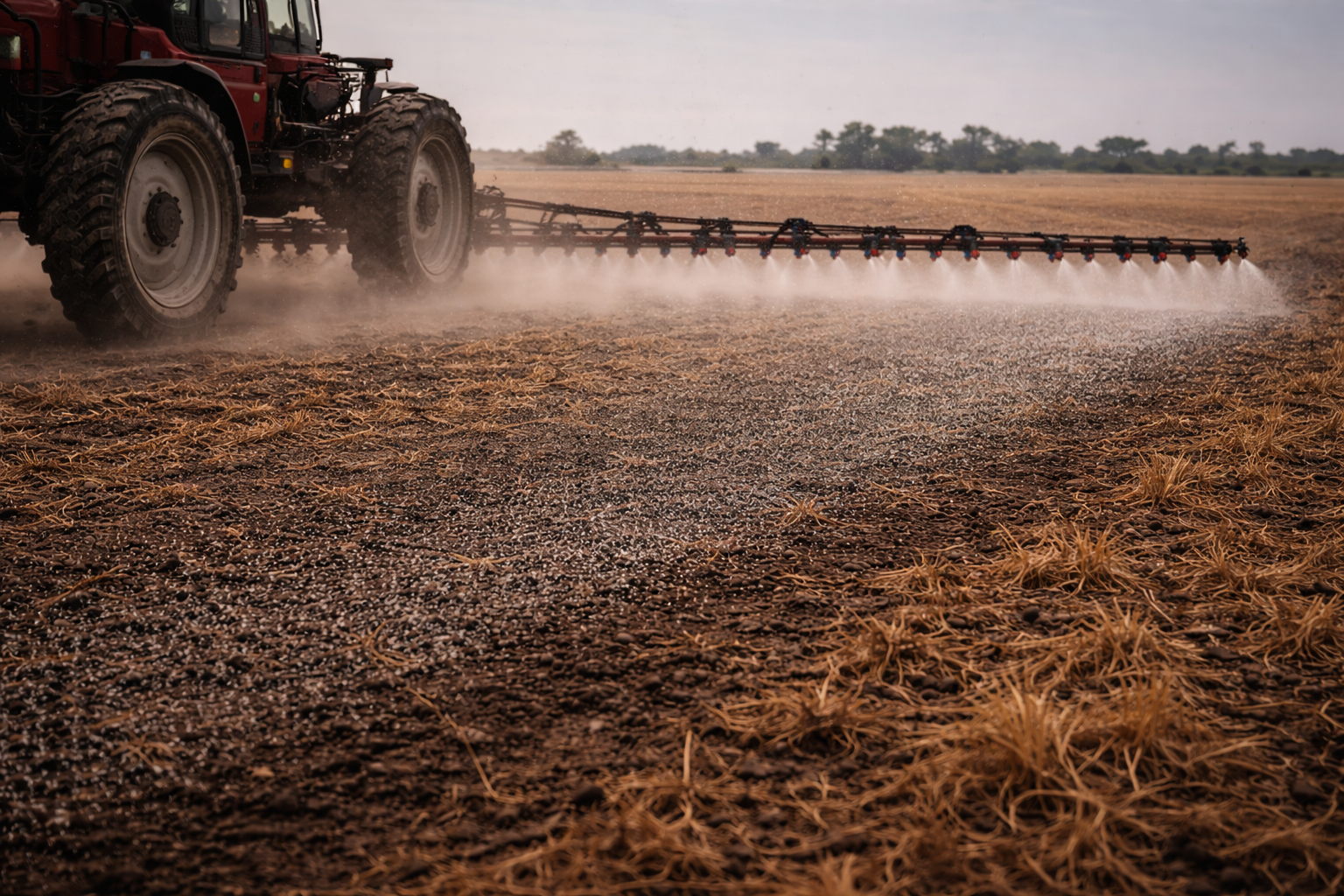
A sprayer that's out of calibration is quietly expensive. Over-apply and you're burning chemical budget for no extra benefit. Under-apply and weeds survive, your program breaks down, and you're up for a re-spray. Across a large broadacre program north of Moree, even a 10% error in application rate multiplies fast. Calibration isn't complicated. It just has to happen.
What Actually Controls Your Application Rate
Three variables determine how much product reaches the soil or crop: travel speed, nozzle output, and boom width. Change any one of them and your application rate shifts. A nozzle that's wearing out doesn't fail dramatically, it drifts gradually. The orifice enlarges, output climbs, and before long you're applying 15% more than the label rate without knowing it.
Calibration at the start of the season is the minimum. On big programs, checking nozzle output mid-season is smarter.
The 30-Second Nozzle Check
Run the sprayer at operating pressure with clean water. Catch the output from each nozzle into a measuring jug for 30 seconds. Average the results across the boom. Any nozzle producing more than 10% above or below the average gets replaced, not adjusted.
This matters for two reasons. Uneven nozzles mean uneven coverage, with some patches overdosed and others underdosed. Worn nozzles also produce finer droplets, and fine droplets drift. Replacing worn nozzles is a drift management decision as much as a rate accuracy one. For a detailed procedure and acceptable variance thresholds, the
GRDC spray application manual is worth having on hand at the start of each season.
Choosing the Right Nozzle for the Job
Product labels in NSW often specify droplet size requirements, so nozzle choice isn't purely a calibration question. Here's how the main types stack up for broadacre applications:
Flat fan nozzles: Standard for most herbicide applications. Medium droplets at normal operating pressure.
Air-induction nozzles: Coarser, drift-resistant droplets. Strong choice when there's sensitive country nearby, and around Moree there usually is.
Twin flat fan nozzles: Spray in two directions, improving coverage and reducing drift risk.
Flooding nozzles: Used for pre-emergent applications where soil coverage matters more than foliar contact.
For 2,4-D applications across the North West Plains, APVMA label nozzle requirements are specific and legally binding. Our article on preventing spray drift covers the drift-reduction angle if that's your primary concern.
Boom Height
Boom height is a rate accuracy issue and a drift issue at the same time. For a 110-degree nozzle on 50 cm spacing, the minimum height for adequate coverage overlap is around 35 to 50 cm above the target. Running higher than that doesn't improve coverage. It creates uneven distribution, with too much product directly under the nozzles and not enough in between, and it increases drift risk on the way there.
💡 Most operators on the black soils run at 50 cm to allow for boom movement over uneven ground. Lower and slower in decent conditions consistently outperforms fast and high.
Checking Your Actual Travel Speed
Your display speed and actual ground speed can differ, particularly in soft or freshly worked country. Before calibration means anything, check actual speed against a measured distance on the ground at your normal operating gear and revs. Changing travel speed mid-job changes your application rate unless you've got a rate controller compensating automatically.
The Quick Rate Check
Spray a measured area at normal operating settings with clean water. Measure the water used from the tank, divide by the area, and compare to the label rate. Takes about 20 minutes. On a 500-hectare job, that 20 minutes is the difference between applying the right rate across all of it or spending the season wondering why results aren't stacking up.
Good calibration also makes the timing argument stronger. A well-set sprayer getting on the job when conditions are right is doing exactly what it should. The ROI of that combination is covered in our article on why spray timing matters.
Gwydir Crop Care is based in Moree and services farms across the Gwydir Valley and North West NSW within 100 km. Warren and the team are ChemCert-accredited, fully insured, and schedule around your season, whether that means early starts, late finishes, or getting on the phone when rain is forecast.
Call Warren: 0488 175 275 | warren@gwydircropcare.com.au | gwydircropcare.com.au