How to Prevent Spray Drift in North West NSW
Spray drift in the Gwydir Valley isn't a theoretical risk. In the 2022-23 season, 48% of NSW cotton growers were affected by off-target spray, costing an average of $254,000 per farm. The country around Moree, Narrabri, Wee Waa and Collarenebri doesn't have the luxury of wide separation between crop types. Wheat, chickpeas and irrigated cotton sit side by side. Getting drift prevention right isn't optional.
Nozzle Selection
Fine droplets drift. Coarse droplets don't. That's the foundation. The goal is the largest droplet size that still delivers effective control and meets label requirements, and for most broadacre herbicide applications in North West NSW, that means air-induction or twin-flat-fan nozzles as the starting point, not standard flat fans.
Standard flat fans at operating pressure produce medium droplets. Air-induction nozzles trap tiny air bubbles inside larger droplets, making them heavier and far more resistant to off-target movement. The difference is significant, especially when you're spraying near cotton.
The APVMA has specific nozzle and droplet size requirements on many labels, particularly 2,4-D products. In cotton country those requirements are legally binding. The APVMA spray drift guidelines lay out what's required for different product types.
Boom Height and Speed
Every extra centimetre of boom height gives a droplet more air time before it reaches the target. More air time means more evaporation and more potential to drift. For a 110-degree nozzle on 50 cm spacing, the minimum height for effective overlap is around 35 to 50 cm above the target. Running higher than that adds risk with no agronomic benefit.
Increased travel speed compounds the problem. It pushes fine droplets into faster-moving air, lifts the spray pattern relative to the boom, and gives the operator less time to notice conditions changing. Slowing down is one of the cheapest drift reduction measures available. On a big flat paddock north of Moree with wind building from the north, the difference between 18 km/h and 24 km/h can be the difference between your paddock and your neighbour's cotton. The GRDC spray manual covers boom height and stability in detail if you want the specifics.
Weather Checks Before Every Job
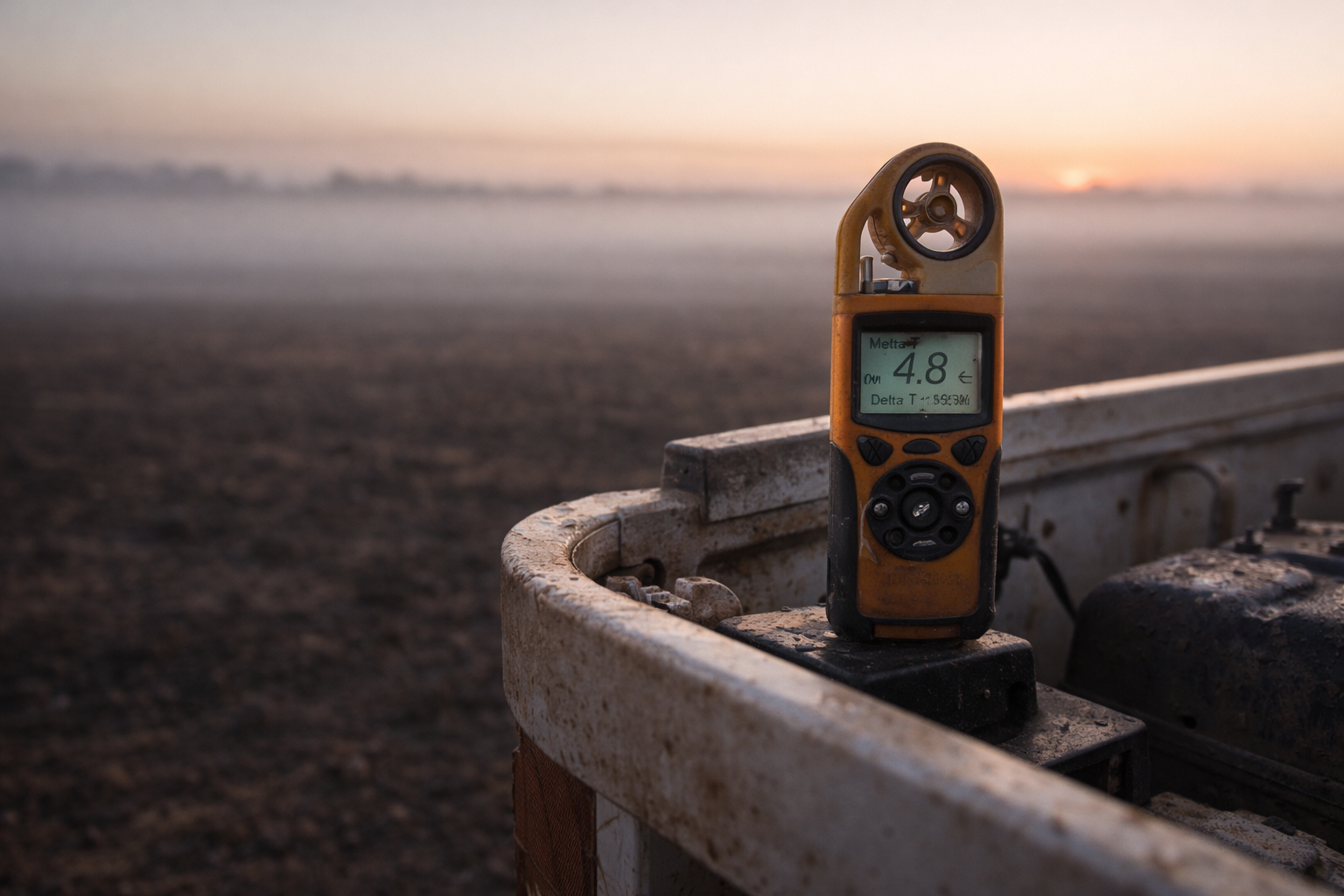
Most drift incidents happen when operators spray in conditions that look acceptable but aren't. These are the four things to check before you start and at the end of every tank.
Wind: 3 to 15 km/h, steady direction away from sensitive crops
Delta T: 2 to 8 is ideal, slow down and reassess between 8 and 10, stop above 10
Inversion risk: flat smoke, no gusts, dew on the ground, smells carrying further than usual — if you're seeing any of those, wait
Temperature: avoid above 30°C with volatile herbicides, especially 2,4-D ester
For a full explanation of what each of those numbers means and why they matter in the Gwydir region specifically, the weather rules article covers it in detail. The GRDC spray drift resources also has real-time inversion data for North West NSW, worth checking before you head out in summer.
Know What's Next Door
Before you spray, it's worth knowing what's growing within range of where your product could drift. Around Moree and Pallamallawa that conversation almost always involves cotton, which is extraordinarily sensitive to 2,4-D and picloram. Chickpeas, canola and grapes are also high-risk neighbours.
Tools like SataCrop and BeeConnected can help you map sensitive crops nearby. In a lot of cases, a quick text to the neighbour the evening before you spray is the most effective drift prevention measure available. It costs nothing and it's sorted more conflicts around Moree than any nozzle upgrade ever has.
Buffer Zones
Buffer zones are the minimum unsprayed distances on product labels, particularly for 2,4-D products near sensitive crops and waterways. They're a legal requirement, not a guideline. Some products require a 30-metre downwind buffer near sensitive areas, others more. The buffer applies in the downwind direction, so when wind shifts mid-job, the buffer zone shifts with it.
If wind direction changes and brings your spray zone within buffer distance of a cotton field, you stop and document why you stopped. For the full legal picture on what that documentation needs to include, see our article on NSW spray regulations.
Talk to Your Neighbours
The Gwydir Valley has had some damaging spray drift seasons, but incidents have reduced in recent years as operators have got better at inversion management and 2,4-D awareness. A big part of that improvement is communication. Growers who talk to their neighbours about spray programs and timing, even informally, have far fewer disputes. It's not legally required in most cases, but it builds the trust that means a small issue gets resolved with a call rather than an EPA report.
If something does go wrong on either side of the fence, our guide on what to do when spray drifts walks through exactly what to do in the first 48 hours.
Gwydir Crop Care is based in Moree and services farms across the Gwydir Valley and North West NSW within 100 km. Warren and the team are ChemCert-accredited, fully insured, and schedule around your season, whether that means early starts, late finishes, or getting on the phone when rain is forecast.
Call Warren: 0488 175 275 | warren@gwydircropcare.com.au | gwydircropcare.com.au