The Weather Rules That Make or Break a Spray Job in NSW
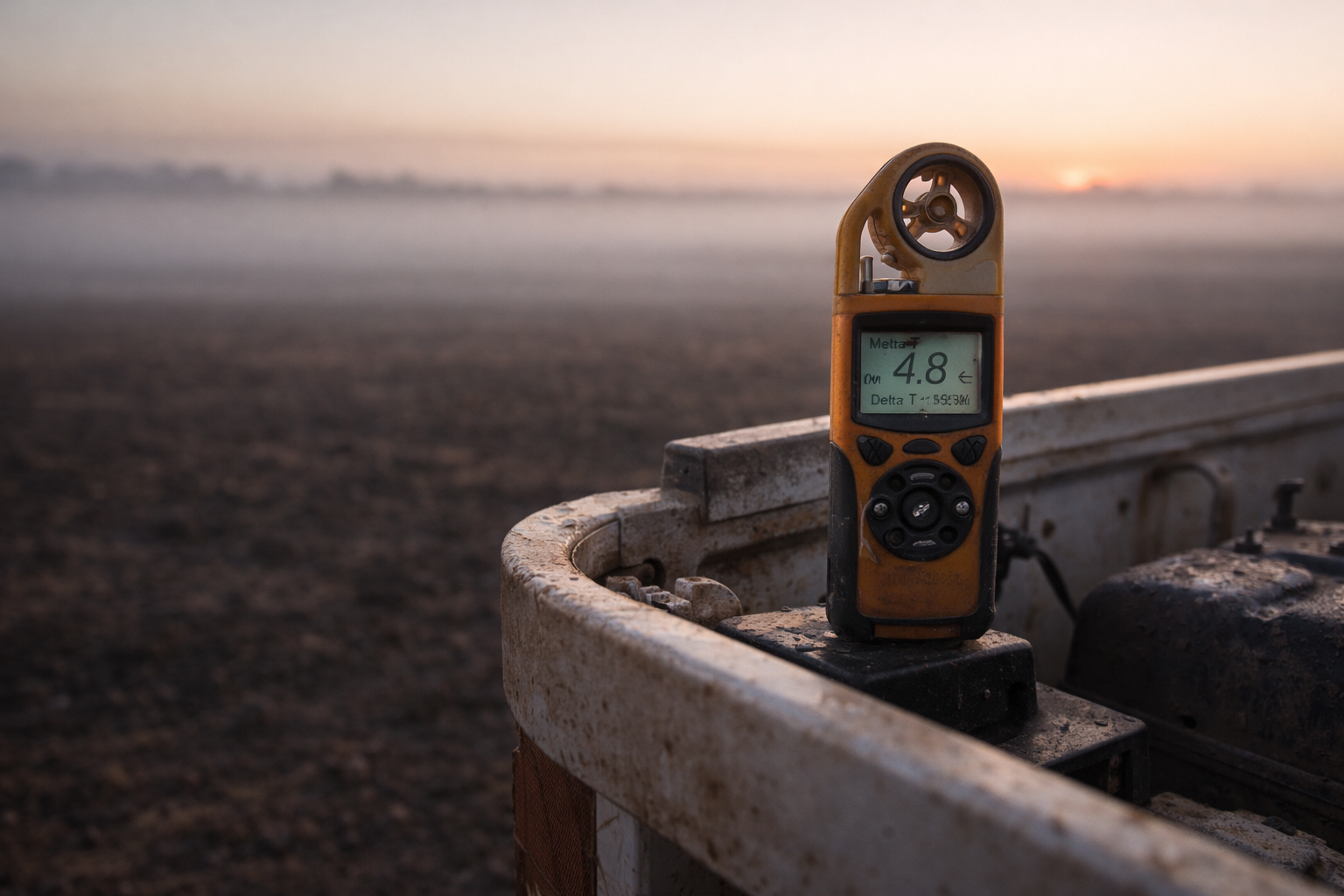
Ask any experienced spray operator on the Moree Plains what kills a spray job and they'll tell you straight — it's not usually the wrong product or the wrong rate. It's the wrong weather. A morning that looks calm, clear and perfect can hide a temperature inversion that'll carry your chemical three paddocks sideways before the droplets hit the ground.
Spray drift has cost Gwydir Valley cotton growers hundreds of thousands of dollars in individual seasons. It's triggered EPA investigations, strained neighbour relationships that took years to build, and wasted entire tank loads of expensive chemistry. Most of it was preventable.
These are the weather rules that matter. Learn them and you'll make better calls — and smarter use of every spray window the season hands you.
Wind Speed: There's a Reason 3–15 km/h Is the Magic Range
Wind is the most visible weather factor and the one most operators think they've got covered. But it's not just about whether it's blowing — it's about how much, how consistently, and in which direction.
The accepted spray window across NSW is 3 to 15 km/h, with a steady direction pointing away from any sensitive crops — and there's a lot of sensitive country around Moree, Pallamallawa, Garah and Mallowa.
Below 3 km/h, you've likely got an inversion forming (more on that shortly). The droplets don't disperse properly and can travel kilometres in a direction you never intended. Above 15 km/h, physical drift risk climbs fast — fine droplets become airborne, and you're spraying for your neighbour as much as yourself.
Gusts are their own trap. As a rule of thumb, gusts shouldn't be more than about one-third above your average speed. If you're averaging 15 km/h, gusts above 20 km/h mean stop and wait.
💡 Always measure wind at the application site — not from the BOM station 50 km away. Conditions on the black soil plains shift fast.
The WAND spray hazard system (Weather And Networked Data) now has towers across North West NSW providing real-time inversion risk data for the region. In summer spray season, 300–400 operators check it every day. It's worth bookmarking.
Temperature Inversions: The One That Catches People Out
A temperature inversion is what happens when the surface of the Moree plains cools overnight under clear skies, trapping a layer of cold, still air at ground level with warmer air sitting on top. The atmosphere becomes stable. Fine spray droplets don't rise. They hang. They drift.
And they don't drift gently in one direction you can predict — they can travel kilometres on very light, variable winds, landing wherever that cool air goes. Some of the most damaging 2,4-D incidents across the Gwydir region happened under exactly these conditions, early mornings that looked perfect but weren't.
The inversion lifecycle on the North West Plains usually follows this pattern: forms from late afternoon as the earth cools, peaks in the hours before and after midnight, and starts breaking up roughly two hours after sunrise — but only if the temperature climbs at least 5°C above the overnight low and wind speed holds above 7 km/h for 45 minutes or more. On a cool, still autumn morning, that can take a while.
You don't need a tower with sensors to spot the signs. Look for these:
Smoke or diesel exhaust that rises a metre or two, then spreads horizontally and hangs
Sounds or smells travelling further than normal (machinery you'd normally barely hear, or grain smells from a neighbour's harvest)
Calm with no gusts, even as the sun gets up
Dew or frost still sitting on the ground an hour after sunrise
If you're seeing any of those, don't spray. The Agriculture Victoria inversion guide is worth a read — the visual checklist is solid. And don't be fooled by light wind at inversion time. A laminar breeze of 4–5 km/h during a hazardous inversion can still carry fine droplets a long way.
Delta T: The Number Every Spray Operator in North West NSW Should Know
Delta T is the difference between your dry bulb and wet bulb temperature readings. It tells you how quickly spray droplets evaporate after leaving the nozzle — which determines whether your chemical actually reaches the plant and does its job, or disappears into thin air.
The numbers that matter, straight from GRDC's Weather Essentials for Pesticide Application:
✅ Delta T 2–8: ideal. Spray with confidence.
⚠️ Delta T 8–10: caution. Go coarser on droplet size, increase water rates.
🚫 Delta T below 2: droplets hang in the air too long. High drift risk. Stop.
🚫 Delta T above 10: droplets evaporate before they hit the target. You're wasting your day.
In summer around Moree, Delta T can hit 10 by 9:30am on a hot, dry January morning. That's your signal to shut down the rig, grab a coffee, and wait for better conditions — or plan to start the following day with a proper mid-morning window once inversions have cleared.
A Kestrel handheld meter or your farm weather station will give you Delta T in real time. The GRDC Weather Essentials guide has the full Delta T chart if you want to understand exactly what the numbers mean at different temperature and humidity combinations.
Heat and Humidity: The Volatile Problem
High temperature isn't just a Delta T problem. Some herbicides — 2,4-D ester products in particular — can vapourise off the leaf after they've been applied. That's vapour drift, not droplet drift, and it's a separate risk that happens after the spray job is done.
In the Gwydir Valley, with cotton grown on hundreds of thousands of hectares, spraying 2,4-D ester in summer when temperatures are pushing 35°C is a serious liability issue. The cotton plant is extraordinarily sensitive to 2,4-D vapour — you can cause cupping and twisting damage at concentrations too low to smell.
The practical rule: avoid spraying above 30°C. Stick to amine formulations of 2,4-D (not esters) in summer in this region, and check the APVMA label requirements — they've been tightened specifically in response to drift incidents in cotton regions like ours. See the NSW EPA spray drift guidelines for the full picture.
Humidity sits on the other end of the equation. Very low humidity (below about 40%) drives up evaporation rates and pushes Delta T higher faster. Very high humidity slows droplet evaporation, extending drift risk if inversions are also present. The window between 50–85% is generally comfortable.
Rain: Before, During, and After
Spraying before rain is almost always a bad idea. Most herbicide labels require a minimum two-hour rain-free period, and that's a minimum — with systemic products, you want the product moving through the plant for several hours before any rainfall hits.
On the black soils north of Moree, thunderstorm activity can build fast in summer. What starts as a clear morning can end with 80mm before lunch — as cotton farmers in the Mallowa district know well from a recent flood event. Checking BOM radar and 24-hour forecasts before you start is non-negotiable in the summer season.
Heavy rain shortly after pre-emergent application can also move product deeper into the soil profile than intended, risking crop damage or moving it out of the weed germination zone altogether. Time pre-emergents with expected light activating rainfall where possible.
Your Records Might Save You One Day
Under NSW pesticide regulations, commercial users must record every application. That includes farmers spraying their own land as part of their business. Records must be kept for a minimum of three years.
What you need to capture at the start of every tank, every day:
Wind speed and direction (measured at the application site)
Temperature and relative humidity
Delta T value
Product applied, rate, and water volume
Start and finish time, paddock location
Applicator name and ChemCert/licence number
If a spray drift complaint lands on your fence, your records are your first and strongest line of defence. They demonstrate you followed the label, worked within the required conditions, and used qualified operators. Without them, that defence doesn't exist.
💡 The WAND app and some farm weather station platforms automatically log conditions at each spray record. That's time well saved at the end of a long day.
Weather Changes. Your Standards Shouldn't.
The North West Plains can hand you 20°C mornings and still air that looks like an ideal spray day — right up until conditions deteriorate faster than expected. A 48% spray drift damage rate across NSW cotton growers in the 2022-23 season, with average losses of $254,000 per affected grower, tells you what's at stake when weather judgment fails.
The flip side is real too: better weather data means more usable windows, not fewer. WAND users reportedly gain an average of four extra hours of spray time per day compared to old conservative rules. Knowing exactly when conditions are safe lets you work longer and more confidently — not just more cautiously.
Want to understand what a tight spray window means for timing your crops? Read our guide on the best time to spray your crops in NSW. And if you want to know how weather-driven decisions translate into physical drift prevention — boom height, nozzle selection, buffer zones — head to our article on how to prevent spray drift in North West NSW.
Gwydir Crop Care runs a tight operation out of Moree, servicing farms across the Gwydir Valley and North West NSW within 100 km. Warren and the team are ChemCert-accredited, fully insured, and work around your season — early starts, late finishes, flexible scheduling.
📞 Call Warren on 0488 175 275 | 📧warren@gwydircropcare.com.au | 🌐gwydircropcare.com.au